Shop By Category
00 items

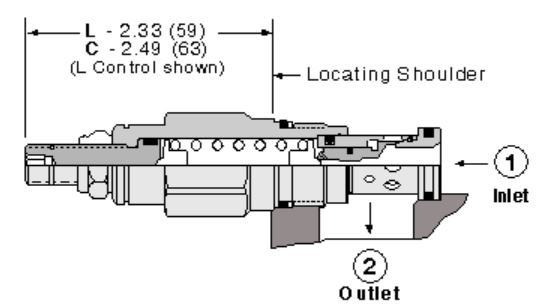

Direct-acting relief cartridges are normally closed, pressure-limiting valves used to protect hydraulic components from pressure transients. When the pressure at the inlet (port 1) reaches the valve setting, the valve starts to open to tank (port 2), throttling flow to limit the pressure rise. These valves are smooth and quiet, essentially zero leak, dirt tolerant, immune to silting and are very fast.


Direct-acting relief cartridges are normally closed, pressure-limiting valves used to protect hydraulic components from pressure transients. When the pressure at the inlet (port 1) reaches the valve setting, the valve starts to open to tank (port 2), throttling flow to limit the pressure rise. These valves are smooth and quiet, essentially zero leak, dirt tolerant, immune to silting and are very fast.

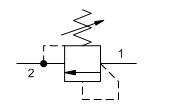
Direct-acting relief cartridges are normally closed, pressure-limiting valves used to protect hydraulic components from pressure transients. When the pressure at the inlet (port 1) reaches the valve setting, the valve starts to open to tank (port 2), throttling flow to limit the pressure rise. These valves are smooth and quiet, essentially zero leak, dirt tolerant, immune to silting and are very fast.


Direct-acting relief cartridges are normally closed, pressure-limiting valves used to protect hydraulic components from pressure transients. When the pressure at the inlet (port 1) reaches the valve setting, the valve starts to open to tank (port 2), throttling flow to limit the pressure rise. These valves are smooth and quiet, essentially zero leak, dirt tolerant, immune to silting and are very fast.


Direct-acting sequence valves with reverse-flow check will supply a secondary circuit with flow once the pressure at the inlet (port 1) has exceeded the valve setting. Additionally, these valves incorporate an integral check valve to provide reverse flow from port 2 (sequence) to port 1 (inlet). The pressure setting of a sequence valve controls the pressure at port 1 relative to the pressure at the drain (port 3).


Direct-acting sequence valves with reverse-flow check will supply a secondary circuit with flow once the pressure at the inlet (port 1) has exceeded the valve setting. Additionally, these valves incorporate an integral check valve to provide reverse flow from port 2 (sequence) to port 1 (inlet). The pressure setting of a sequence valve controls the pressure at port 1 relative to the pressure at the drain (port 3).


Direct-acting sequence valves with reverse-flow check will supply a secondary circuit with flow once the pressure at the inlet (port 1) has exceeded the valve setting. Additionally, these valves incorporate an integral check valve to provide reverse flow from port 2 (sequence) to port 1 (inlet). The pressure setting of a sequence valve controls the pressure at port 1 relative to the pressure at the drain (port 3).
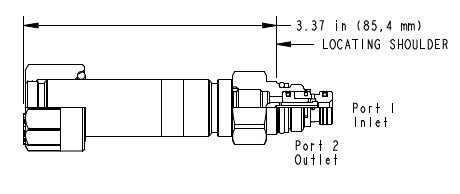
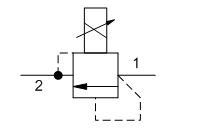
This 2-port, pilot-stage, direct-acting relief cartridge is an electro-proportionally controlled, pressure regulating valve. The proportional control allows for infinite, step-less adjustability within the selected pressure range. When the pressure at port 1 (inlet) is sufficient to overcome the solenoid forces, as determined by the analog input signal, the poppet lifts and allows flow from port 1 to port 2 (outlet). This pilot control cartridge utilizes the T-8A cavity so it can be used in conjunction with Sun's main stage, pressure control elements.


Fast-acting, pilot-operated, balanced piston relief cartridges are normally closed, pressure-limiting valves used to protect hydraulics components from pressure transients. Fast opening and closing is gained at the expense of smoothness. When the pressure at the inlet (port 1) reaches the valve setting, the valve starts to open to tank (port 2), throttling flow to limit the pressure rise. These valves have low pressure rise vs. flow and are very fast.


Kick-down relief cartridges act similar to a circuit breaker in an electrical system. The valves will kick completely open and remain open once the pressure at the inlet (port 1) exceeds the valve settting, creating an unrestricted flow path from port 1 to tank (port 2). The valve remains open as long as the pressure at port 1 exceeds the pressure at port 2. To reset the valve, flow from port 1 to port 2 must cease and pressure at port 2 must be equal to or greater than the pressure at port 1.


Pilot-operated, balanced-piston relief cartridges are normally closed pressure regulating valves. When the pressure at the inlet (port 1) reaches the valve setting, the valve starts to open to tank (port 2), throttling flow to regulate the pressure. These valves are accurate, have low pressure rise vs. flow, they are smooth and quiet, and are moderately fast.
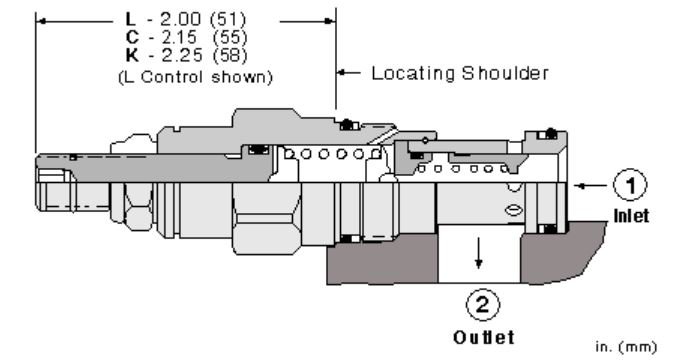
Pilot-operated, balanced-piston relief cartridges are normally closed pressure regulating valves. When the pressure at the inlet (port 1) reaches the valve setting, the valve starts to open to tank (port 2), throttling flow to regulate the pressure. These valves are accurate, have low pressure rise vs. flow, they are smooth and quiet, and are moderately fast.
