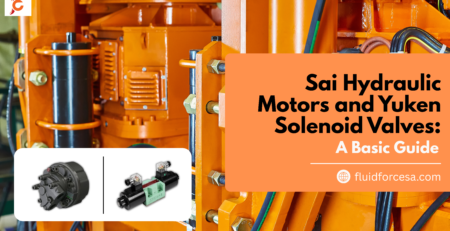
AYuken solenoid valve delivers fast, electrically controlled directional switching in hydraulic systems, allowing operators to start, stop, or reverse cylinder and motor movement with high reliability. These valves form a core part of many industrial and mobile circuits where consistent response and compact mounting are essential. Fluid Force supplies quality hydraulic components, including directional and pressure control solutions, to support efficient system design and maintenance across South African and regional applications.
Definition
A Yuken solenoid valve is a spool-type directional control valve actuated by one or more electromagnetic coils. When energised, the coil shifts the spool to connect the pump (P), tank (T), and work ports (A/B) in the required pattern. Most industrial models follow international mounting standards such as CETOP 03 or CETOP 05 and are designed for continuous-duty industrial environments with pressures commonly reaching 210–315 bar depending on size and series.
Benefits / Importance
These valves bring several operational strengths:
Rapid response to electrical signals for precise actuator control
Compact footprint that fits easily into manifold or sub-plate assemblies
Multiple spool options (spring-centred, detented, open or closed centre) to match circuit needs
Proven durability under continuous industrial cycling
Compatibility with standard hydraulic fluids and filtration practices
Reduced need for complex mechanical linkages or manual levers
In applications where downtime is costly, a reliable solenoid directional valve keeps machines productive and simplifies remote or automated control.
How Yuken Solenoid Valves Fit into Complete Systems
Directional valves rarely work in isolation. They sit alongside pumps, manifolds, actuators, and pressure-control devices. When a system requires different pressure levels in separate branches, a pressure reducing valve becomes the natural partner. The combination allows the main circuit to run at higher pressure while protecting sensitive downstream components with a stable lower pressure.
Key Selection Factors for Solenoid Directional Valves
Choosing the right valve involves matching:
Flow rate and maximum system pressure
Mounting interface (CETOP size)
Number of positions and spool centre configuration
Coil voltage and connector style (DC or AC options)
Environmental protection rating for the coil
Fluid type and expected contamination level
Correct matching avoids excessive heat, pressure drop, or premature wear.
Yuken Pressure Reducing Valve in Hydraulic Circuits
A Yuken pressure reducing valve maintains a constant reduced pressure in a secondary circuit regardless of fluctuations in the primary system pressure. Modular and sub-plate versions integrate cleanly with directional valves on the same manifold, saving space and simplifying piping. Typical uses include clamp circuits, pilot lines, and any branch that must operate at a lower, stable pressure for safety or process reasons.
Practical Comparison of Control Functions
Function
Solenoid Directional Valve
Pressure Reducing Valve
Primary role
Directs fluid path
Limits and stabilises secondary pressure
Actuation
Electrical (solenoid)
Mechanical / pilot-operated
Typical mounting
CETOP sub-plate or modular stack
Modular or in-line
Key benefit
Remote / automated motion control
Protects components and processes
Common pairing
With manifolds and power units
With directional valves on shared stack
Together they create efficient, multi-function circuits without excessive external piping.
Installation and Service Considerations
Mount valves on clean, flat surfaces with correct bolt torque. Maintain recommended filtration (usually 10–25 µm) and use fluids within the viscosity and temperature ranges specified by the manufacturer. Regular inspection of coil condition, spool movement, and seal integrity helps prevent unexpected failures. Always isolate and depressurise the system before any maintenance work.
Typical Industrial Applications
Yuken-style solenoid valves and pressure reducing valves appear in:
Machine tools and automated production lines
Presses and forming equipment
Material-handling systems
Injection-moulding and die-casting machines
Mobile and industrial power units
Custom hydraulic manifolds and power packs
FAQ
What voltage options are common for Yuken solenoid valves?
24 V DC is widely used in modern control systems. AC voltages such as 110 V or 220/240 V remain available for older or specific regional installations.
Can a pressure reducing valve be stacked with a solenoid directional valve?
Yes. Modular designs allow both functions to share the same manifold stack, reducing overall footprint and leak points.
How do I know which spool type I need?
The circuit diagram and desired actuator behaviour determine the choice. Common options include closed-centre (all ports blocked), open-centre (P connected to T), and tandem configurations.
What maintenance extends valve life?
Clean fluid, correct filtration, proper torque on mounting bolts, and protection of electrical connections from moisture and vibration are the most effective measures.
Are these valves suitable for continuous duty?
Many industrial series are designed for continuous energisation when the correct coil rating and heat dissipation are observed.
Conclusion
Yuken solenoid valves provide dependable electrical control of hydraulic direction, while Yuken pressure reducing valves add precise secondary pressure management. When selected and installed correctly, they form reliable building blocks for industrial and mobile systems.
Fluid Force supports customers with a practical range of hydraulic components, manifolds, and power units suited to local operating conditions. Whether you are designing a new circuit or maintaining existing equipment, choosing the right directional and pressure-control valves helps keep performance consistent and downtime low.
Author Bio
The author is an industrial and hydraulic technology content writer specializing in fluid power, hydraulic systems, industrial components, and machinery maintenance. With a focus on practical and technically grounded content, the author explains complex hydraulic concepts in a way that is useful for engineers, maintenance professionals, procurement teams, and industrial decision-makers.
A hydraulic machine rarely fails because of one dramatic problem.
More often, performance starts slipping gradually. A cylinder becomes slower than usual. A...
In today’s industrial hydraulic systems, pressure control is no longer just about protection, it’s about efficiency, flexibility and remote operation. A...
Dowty hydraulic pumps are external gear pumps that powered a wide range of agricultural, construction, mobile, and industrial equipment for decades. Although...