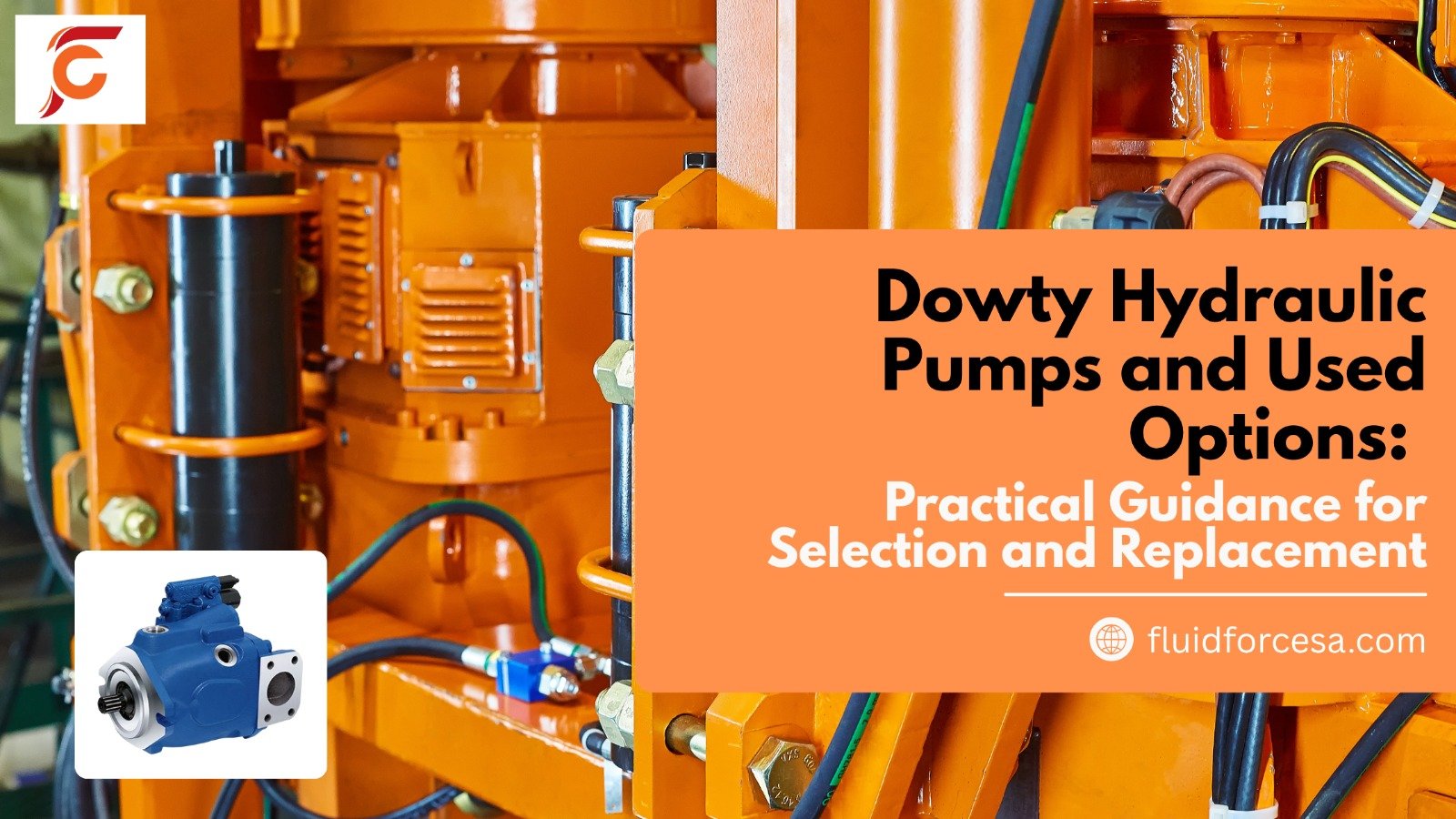
Dowty hydraulic pumps are external gear pumps that powered a wide range of agricultural, construction, mobile, and industrial equipment for decades. Although original production has ended, many machines still rely on these units, creating ongoing demand for both compatible replacements and carefully inspected Dowty used hydraulic pumps.
This guide covers what these pumps are, how they operate, where they were typically fitted, and the practical steps for selecting a suitable unit when the original fails.
What Are Dowty Hydraulic Pumps?
Dowty Hydraulic Units produced several series of external gear pumps, most commonly the P3000 and P4000 ranges (often identified as Group 1P and 2P). These positive-displacement pumps use two meshing gears to move hydraulic fluid from the inlet to the outlet.
Because the original pumps are no longer manufactured, correct identification of displacement, pressure rating, mounting flange, shaft details, port configuration, and rotation direction is essential when sourcing a replacement. Matching these parameters allows the rest of the hydraulic system to continue operating without major redesign.
How a Dowty Gear Pump Works
Two gears rotate inside a precision housing. Fluid enters at the inlet, is carried around the periphery of the gears, and is forced out through the outlet as the teeth mesh. The close fit between gears and housing minimizes internal leakage and produces a relatively steady flow proportional to shaft speed.
Performance depends on displacement (volume per revolution), operating pressure, speed, fluid condition, and the overall health of the circuit. Wear on gears, bushings, or seals reduces volumetric efficiency and can lead to noise, heat, or loss of pressure.
Typical Applications
Dowty gear pumps were widely used in:
Agricultural machinery and tractors
Construction and earth-moving equipment
Material-handling systems
Mobile hydraulic circuits
Industrial power units and specialist machines
Many of these applications still run original or equivalent pumps. When a unit fails, the priority is usually a direct mechanical and hydraulic match so that downtime is minimized. Hydraulic power units that incorporate gear pumps form a common part of these systems; more information on available units can be found in the hydraulic power units category.
Selection Factors
Accurate matching requires attention to several technical details. The table below summarizes the most important ones:
Factor
Why It Matters
What to Verify
Displacement
Determines flow rate at given speed
cc/rev or in³/rev from nameplate or data
Pressure rating
Must meet system operating and peak pressures
Continuous and intermittent ratings
Mounting
Ensures correct installation
Flange type, bolt pattern, pilot diameter
Shaft
Mechanical drive compatibility
Diameter, keyway or spline, length
Porting
Fluid connections
Thread size, position, orientation
Rotation
Must match drive direction
Clockwise or counter-clockwise
Fluid
Compatibility with seals and materials
Viscosity range and cleanliness level
A mismatch in any of these areas can cause installation problems or premature failure.
New Equivalents Versus Used Dowty Hydraulic Pumps
New compatible gear pumps are available for many original Dowty models and offer full remaining service life with known condition. Used or refurbished Dowty hydraulic pumps can be a practical option when a direct modern equivalent is difficult to source or when budget constraints apply, provided the unit has been properly inspected and tested.
When evaluating a used pump, request:
Clear photographs of the nameplate, shaft, and ports
Dimensional measurements if markings are worn
Test results for flow and pressure
Information on seal replacement and overall condition
A well-checked used unit can deliver reliable service, but condition data should be treated as essential.
Practical Steps for Replacement
Record every number and marking on the existing pump and take clear photographs.
Note the direction of rotation and the mounting orientation.
Confirm system pressure, required flow, and fluid type.
Compare candidate pumps against the full list of mechanical and hydraulic parameters.
Ensure filtration and fluid cleanliness meet the requirements of the replacement pump before installation.
Taking these steps reduces the risk of ordering an incompatible unit. Complementary components such as manifold blocks are often part of the same circuit; see the hydraulic manifold blocks range for related options. Overall hydraulic solutions and support are available through the main Fluid Force site.
Frequently Asked Questions
Are original Dowty hydraulic pumps still made? No. Production of the original ranges ended years ago. Compatible modern gear pumps that match critical dimensions and performance are available for many models.
Is a used Dowty hydraulic pump a viable option? Yes, when the unit has been inspected, tested, and is mechanically and hydraulically compatible with the original application.
What is the most common reason a replacement fails to fit? Incorrect matching of shaft, mounting flange, rotation, or displacement. These interfaces must match exactly for a straightforward swap.
How can I identify an unmarked or worn Dowty pump? Provide any remaining numbers, photographs of the shaft end and ports, approximate physical size, and details of the original machine if known. These allow cross-referencing to known series and equivalents.
Do these pumps need special hydraulic fluid? They generally operate with standard hydraulic oils within the viscosity and temperature ranges specified for gear pumps. Cleanliness and proper filtration remain critical for service life.
Conclusion
Dowty hydraulic pumps remain relevant because large numbers of machines still depend on them. Whether the requirement is a new compatible unit or a carefully evaluated used Dowty hydraulic pump, success depends on accurate matching of displacement, pressure capability, mounting, shaft details, porting, and rotation.
When these parameters are correctly identified and the pump is installed with clean fluid and adequate filtration, the hydraulic system can continue to deliver reliable performance. Focusing on technical compatibility rather than brand name alone is the most effective way to keep older equipment productive.
Author Bio: Fluid Force Team Fluid Force supplies hydraulic components including power units, manifold blocks, and related solutions for industrial and mobile equipment, supporting reliable system performance and reduced downtime.
In today’s industrial hydraulic systems, pressure control is no longer just about protection, it’s about efficiency, flexibility and remote operation. A...
Hydraulic systems depend on precise pressure control and reliable flow direction to keep industrial operations running safely and efficiently. Two components that...