Shop By Category
00 items

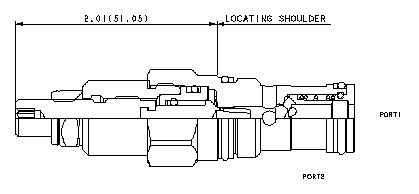
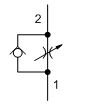
Needle valves with reverse-flow check are fully adjustable orifices used to regulate flow. They are infinitely adjustable from fully closed up to the maximum orifice diameter. An integral high-capacity check valve provides unrestricted flow from port 2 to port 1. They are not pressure compensated.


Needle valves with reverse-flow check are fully adjustable orifices used to regulate flow. They are infinitely adjustable from fully closed up to the maximum orifice diameter. An integral high-capacity check valve provides unrestricted flow from port 2 to port 1. They are not pressure compensated.

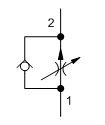
Fully adjustable, pressure-compensated flow controls with reverse-flow check provide precise flow regulation for meter-in or meter-out applications where there may be wide pressure fluctuations. They are infinitely adjustable from nearly closed up to the maximum flow. An integral high-capacity check valve provides unrestricted flow from port 2 to port 1.


Kick-down relief cartridges act similar to a circuit breaker in an electrical system. The valves will kick completely open and remain open once the pressure at the inlet (port 1) exceeds the valve settting, creating an unrestricted flow path from port 1 to tank (port 2). The valve remains open as long as the pressure at port 1 exceeds the pressure at port 2. To reset the valve, flow from port 1 to port 2 must cease and pressure at port 2 must be equal to or greater than the pressure at port 1.
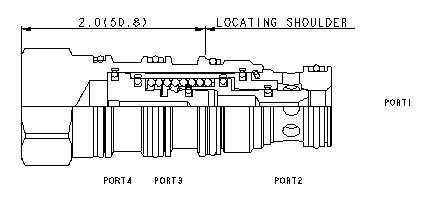
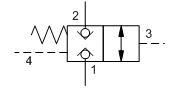
This is a normally closed, balanced poppet, switching element. Pilot pressure at port 3 shifts the valve to the open position.
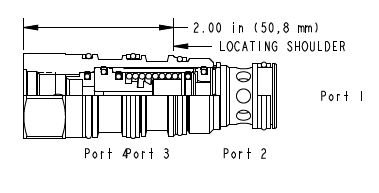

This is a normally closed, balanced poppet, switching element with an integral T-8A control cavity. With a 2-way valve in the closed position installed in the T-8A control cavity, the poppet remains closed. Opening the 2-way valve shifts the poppet to the open position, provided there is sufficient pressure at port 3.


This is a normally closed, balanced poppet, switching element with an integral T-8A control cavity. With a 2-way valve in the closed position installed in the T-8A control cavity, the poppet remains closed. Opening the 2-way valve shifts the poppet to the open position, provided there is sufficient pressure at port 3.


Pilot-operated, balanced-piston relief cartridges are normally closed pressure regulating valves. When the pressure at the inlet (port 1) reaches the valve setting, the valve starts to open to tank (port 2), throttling flow to regulate the pressure. These valves are accurate, have low pressure rise vs. flow, they are smooth and quiet, and are moderately fast.
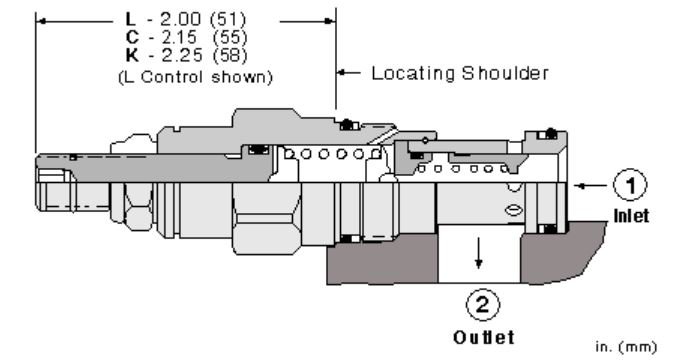
Pilot-operated, balanced-piston relief cartridges are normally closed pressure regulating valves. When the pressure at the inlet (port 1) reaches the valve setting, the valve starts to open to tank (port 2), throttling flow to regulate the pressure. These valves are accurate, have low pressure rise vs. flow, they are smooth and quiet, and are moderately fast.
