Shop By Category
00 items


Counterbalance valves with pilot assist are meant to control an overrunning load. The check valve allows free flow from the directional valve (port 2) to the load (port 1) while a direct-acting, pilot-assisted relief valve controls flow from port 1 to port 2. Pilot assist at port 3 lowers the effective setting of the relief valve at a rate determined by the pilot ratio. Other names for this valve include motion control valve and over-center valve.


Counterbalance valves with pilot assist are meant to control an overrunning load. The check valve allows free flow from the directional valve (port 2) to the load (port 1) while a direct-acting, pilot-assisted relief valve controls flow from port 1 to port 2. Pilot assist at port 3 lowers the effective setting of the relief valve at a rate determined by the pilot ratio. Other names for this valve include motion control valve and over-center valve.


Counterbalance valves with pilot assist are meant to control an overrunning load. The check valve allows free flow from the directional valve (port 2) to the load (port 1) while a direct-acting, pilot-assisted relief valve controls flow from port 1 to port 2. Pilot assist at port 3 lowers the effective setting of the relief valve at a rate determined by the pilot ratio. Other names for this valve include motion control valve and over-center valve.
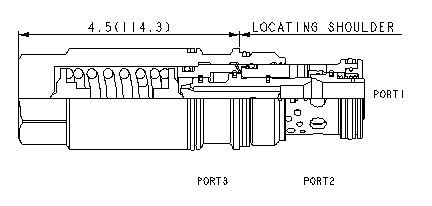
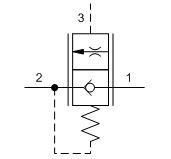
Balanced load control valves combine a balanced modulating element with a reverse flow check. The check valve allows free flow from the directional valve (port 2) to the load (port 1) while the pilot to open modulating element controls flow from port 1 to port 2. Pilot pressure at port 3 determines the flow setting.
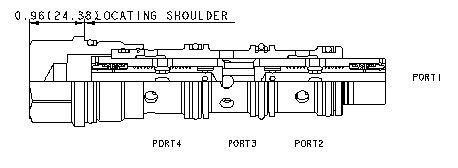

Closed-center flow divider/combiners are sliding-spool, pressure-compensated devices used to split flow in one direction and combine flow in the opposite direction. These valves may be used to accurately control two or more cylinders or hydraulic motors where bidirectional operation is required.


Two-port, pilot-stage, direct-acting relief cartridges are fully adjustable, normally closed pressure regulating valves. When the pressure at port 1 (inlet) is sufficient to overcome the spring force (valve setting), a flow path is opened from port 1 to port 2 (tank).
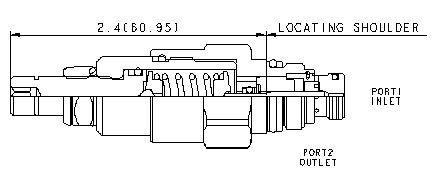

Two-port, pilot-stage, direct-acting relief cartridges are fully adjustable, normally closed pressure regulating valves. When the pressure at port 1 (inlet) is sufficient to overcome the spring force (valve setting), a flow path is opened from port 1 to port 2 (tank).
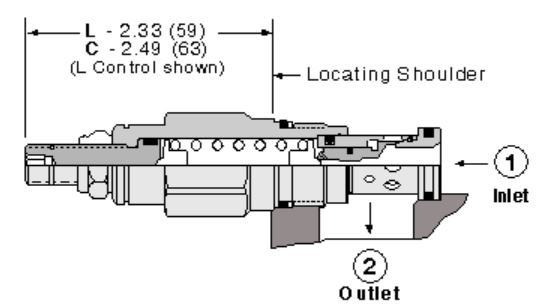

Direct-acting relief cartridges are normally closed, pressure-limiting valves used to protect hydraulic components from pressure transients. When the pressure at the inlet (port 1) reaches the valve setting, the valve starts to open to tank (port 2), throttling flow to limit the pressure rise. These valves are smooth and quiet, essentially zero leak, dirt tolerant, immune to silting and are very fast.
Direct-acting relief cartridges are normally closed, pressure-limiting valves used to protect hydraulic components from pressure transients. When the pressure at the inlet (port 1) reaches the valve setting, the valve starts to open to tank (port 2), throttling flow to limit the pressure rise. These valves are smooth and quiet, essentially zero leak, dirt tolerant, immune to silting and are very fast.
