Hydraulic systems are the driving force behind many industrial, agricultural, construction, and mobile machines. From controlling the movement of hydraulic cylinders to powering rotary equipment, every component has a specific role in keeping a hydraulic circuit efficient and reliable.
For businesses sourcing hydraulic components, Yuken directional valve solutions andDanfoss orbital motors distributors are two important search categories. While these products perform different functions, both play an essential role in hydraulic power transmission and control.
What Is a Yuken Directional Valve?
A Yuken directional valve is a hydraulic control component used to regulate the direction of fluid flow within a hydraulic circuit. By controlling where pressurized hydraulic fluid travels, a directional valve can control the movement of hydraulic cylinders, motors, and other actuators.
In simple terms, the hydraulic pump generates flow, while the directional valve helps determine where that flow goes.
Depending on the valve configuration, it can help control functions such as:
Forward and reverse movement
Cylinder extension and retraction
Starting and stopping hydraulic actuators
Switching between different hydraulic circuits
Controlling the direction of hydraulic motors
Directional control is particularly important in machinery where precise and repeatable movement is required.
Why Are Directional Valves Important?
Imagine a hydraulic machine without a component controlling the path of its hydraulic fluid. The pump could generate flow, but the system would have limited control over where that energy is directed.
A directional valve essentially acts as a traffic controller for hydraulic fluid.
The valve changes the flow path according to the required operation, allowing the machine to perform different hydraulic functions.
What Are Danfoss Orbital Motors?
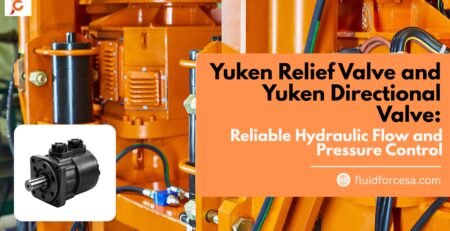
While a directional valve controls hydraulic flow, an orbital motor converts hydraulic energy into rotary mechanical motion.
Danfoss orbital motors are hydraulic motors designed for applications requiring controlled rotary movement. Orbital motors can be found across a wide range of mobile and industrial equipment where hydraulic power needs to be converted into mechanical rotation.
Common applications can include:
Agricultural machinery
Construction equipment
Material-handling equipment
Conveyor systems
Forestry machinery
Industrial machines
Specialized mobile equipment
The exact motor selection depends on factors such as displacement, torque, speed, pressure, flow, mounting configuration, and application requirements.
How Do These Components Work Together?
A directional valve and hydraulic motor may have very different functions, but they can operate together within the same hydraulic circuit.
For example:
Pump → Yuken Directional Valve → Hydraulic Motor → Return Line
The pump supplies hydraulic fluid, the directional valve controls the direction of the flow, and the hydraulic motor converts that hydraulic energy into rotary motion.
This combination can be useful in machinery requiring controlled forward and reverse rotation.
Yuken Directional Valve vs Danfoss Orbital Motor
Component
Primary Function
Converts/Controls
Typical Application
Yuken Directional Valve
Controls fluid direction
Hydraulic flow
Cylinders, motors and hydraulic circuits
Danfoss Orbital Motor
Produces rotary motion
Hydraulic energy into mechanical energy
Agricultural, industrial and mobile machinery
Hydraulic Pump
Generates hydraulic flow
Mechanical energy into hydraulic energy
Hydraulic power units and machinery
Hydraulic Cylinder
Produces linear movement
Hydraulic energy into linear force
Lifting, pushing and positioning
Understanding these differences is important when selecting replacement components or designing a new hydraulic system.
What Should You Consider Before Buying Hydraulic Components?
Selecting a hydraulic component simply because it fits physically may not be enough. The component should also match the hydraulic and mechanical requirements of the application.
Consider:
Operating Pressure
The component should be appropriate for the system’s operating and peak pressure requirements.
Flow Rate
Hydraulic flow affects motor speed and the performance of other hydraulic actuators.
Torque and Speed
When selecting an orbital motor, required torque and rotational speed are important specifications.
Mounting and Connections
Check mounting dimensions, shaft configuration, ports, and other connection requirements before ordering.
Application Conditions
Temperature, operating environment, duty cycle, contamination levels, and load conditions can all influence component selection.
Why Choose an Experienced Hydraulic Supplier?
Finding the right hydraulic component can sometimes be challenging because product specifications vary significantly between applications.
A knowledgeable supplier can help customers identify appropriate products based on:
Hydraulic circuit requirements
Pressure and flow
Motor speed and torque
Existing equipment
Replacement requirements
Installation specifications
Application conditions
For businesses looking for Danfoss orbital motors distributors, technical product knowledge can be particularly valuable when selecting the appropriate motor configuration.
The Importance of Genuine Hydraulic Components
Hydraulic equipment often operates under demanding pressure and load conditions. Using components that are appropriate for the application can help support reliable system performance and reduce avoidable maintenance issues.
Before purchasing, businesses should verify product specifications, compatibility, supplier credentials, and after-sales support.
Frequently Asked Questions
1. What is a Yuken directional valve used for?
A Yuken directional valve is used to control the direction of hydraulic fluid within a hydraulic circuit, helping operate cylinders, hydraulic motors, and other actuators.
2. What are Danfoss orbital motors used for?
Danfoss orbital motors are used to convert hydraulic energy into rotary mechanical motion and can be applied in agricultural, construction, industrial, material-handling, and mobile machinery.
3. Can a directional valve control a hydraulic motor?
Yes. A suitable directional control valve can control the direction of hydraulic flow supplied to a hydraulic motor, allowing functions such as forward and reverse rotation where the circuit is designed for it.
4. How do I select an orbital motor?
Motor selection depends on factors such as required torque, speed, displacement, pressure, flow rate, mounting configuration, and the specific operating conditions of the machine.
5. What should I check before buying a Yuken directional valve?
Check the required pressure and flow, valve configuration, port size, mounting arrangement, actuation method, and compatibility with the existing hydraulic circuit.
6. How can I find reliable Danfoss orbital motors distributors?
Look for a hydraulic supplier that can provide appropriate product specifications, genuine components, application guidance, availability, and technical support.
Final Thoughts
Hydraulic systems work best when every component is correctly matched to the application. AYuken directional valve can provide essential control over hydraulic flow, while Danfoss orbital motors can convert hydraulic power into controlled rotary movement.
If you’re sourcing hydraulic components or looking for Danfoss orbital motors distributors, evaluating specifications, compatibility, application requirements, and supplier expertise can help you identify the right solution.
Explore Fluid Force SA to learn more about hydraulic components and solutions for industrial and mobile hydraulic applications.
About the Author
Fluid Force SA provides hydraulic components and solutions for industrial and mobile applications, supporting businesses with hydraulic products, technical information, and application-focused solutions.
A hydraulic machine rarely fails because of one dramatic problem.
More often, performance starts slipping gradually. A cylinder becomes slower than usual. A...
In today’s industrial hydraulic systems, pressure control is no longer just about protection, it’s about efficiency, flexibility and remote operation. A...
Dowty hydraulic pumps are external gear pumps that powered a wide range of agricultural, construction, mobile, and industrial equipment for decades. Although...